.jpg)

Over 30 parks and green spaces in Gdańsk cover a combined surface exceeding 6,000 hectares.
Each park below comes with specific routes, hours when the paths are empty, and tips drawn from real walks around the city. A quick guide to which park fits which kind of day, plus an idea for what to do when your legs say “enough” and your appetite is just getting started.
Park Oliwski. Baroque Alleys, a Japanese Garden, and a Palm House With Free Entry
Park Oliwski is the oldest park in northern Poland. Its origins reach back to the turn of the 12th and 13th centuries, when Cistercian monks established a utility garden next to their monastery. Spanning over 11 hectares in Gdańsk's Oliwa district, the park combines three distinctly different zones, from a Baroque French garden with symmetrical alleys, through an English-Chinese section with winding paths and gazebos, to a botanical garden with a tropical palm house reopened in 2022 after years of renovation.
Walking through Park Oliwski never feels repetitive. Every turn reveals a different character within the same grounds. Geometric garden parterres give way to dense, shaded paths along streams, and then the view opens again onto a pond full of swans. The entire composition dates back to Abbot Jacek Rybiński and gardener Hentschel, who gave the park its Linden Alley, the Baroque French section, and the garden parterre with the Mickiewicz monument. The English-Chinese section, added in 1782, was meant to reference Asian gardens and introduced a freer layout with hillocks, footbridges, and water basins.
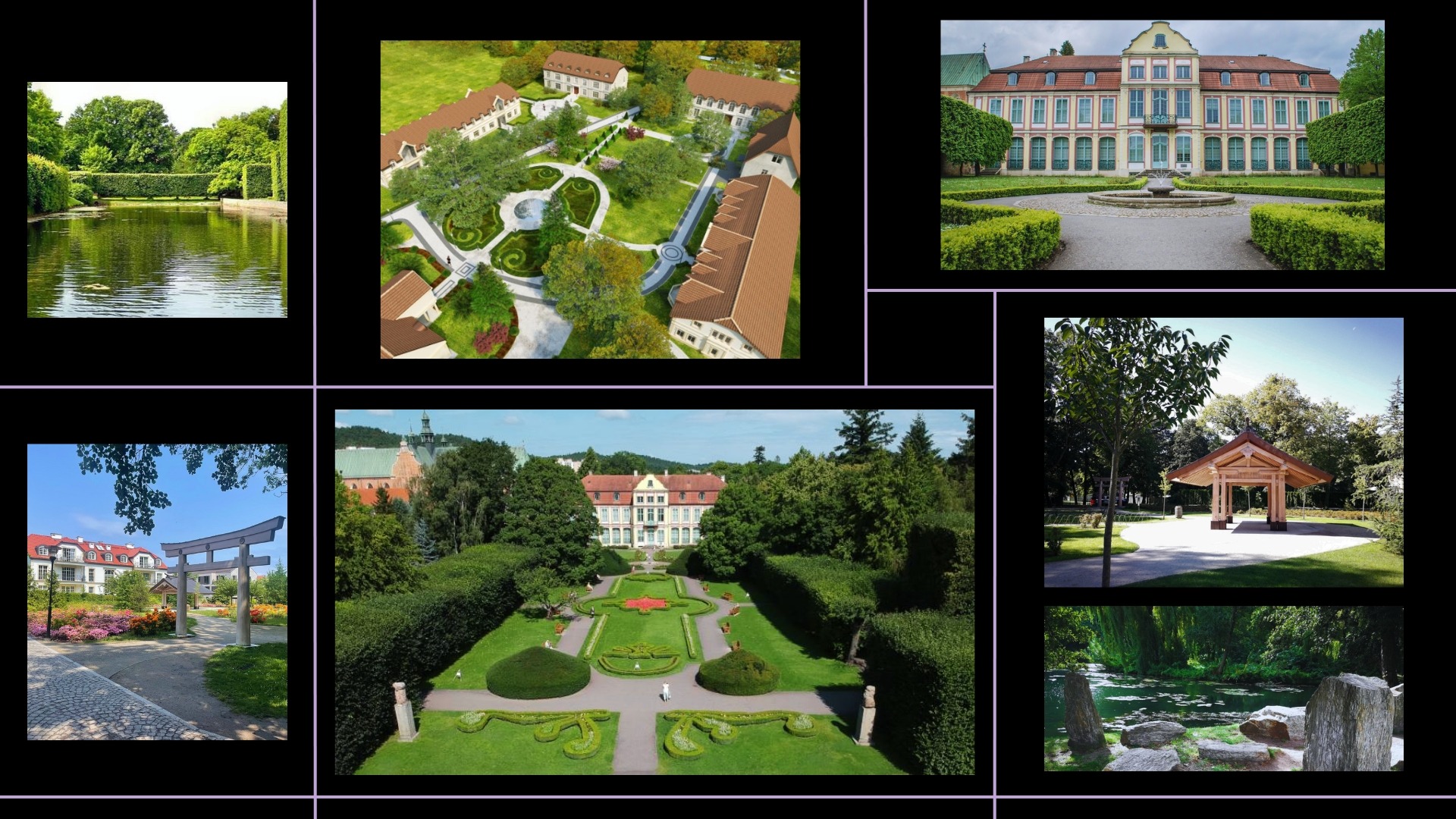
Park Oliwski's Quieter Side
The Whispering Grotto (also called the "Ears of Dionysius") consists of two stone niches on opposite sides of an alley. A whisper spoken in one grotto carries to the other across a distance of several meters. Before 9:00 AM, the acoustics work more clearly because the background noise of conversations hasn't built up yet.

Książęcy Widok (the Princely View) is a historical sight line running from the palace, across the pond, toward the Bay of Gdańsk three kilometers away. The original design created the illusion that the pond water "merged" with the sea. Residential buildings have weakened the effect, but at the right angle the illusion still holds.
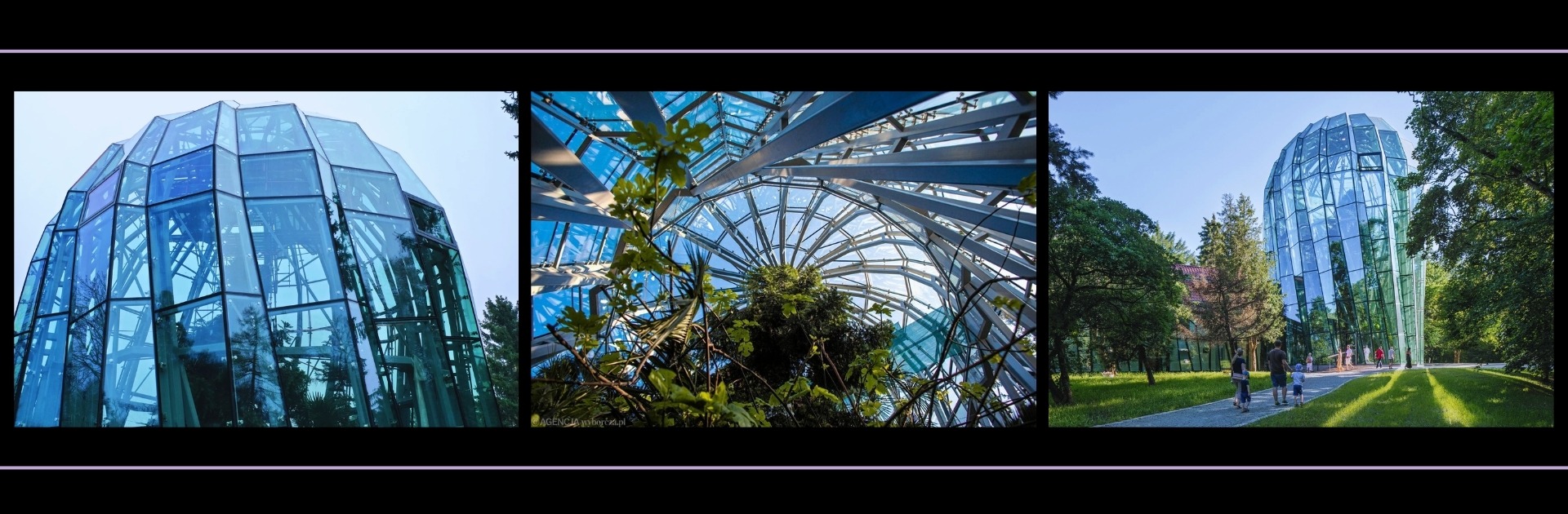
The Palm House sits east of the Abbots' Palace. Admission is free, and opening hours run Tuesday through Sunday, 10:00 AM to 6:00 PM. The collection covers tropical and subtropical plants, and the glass structure of the building impresses even from outside.
The Japanese Garden sits by the pond, at the northern edge of the park, and operates on entirely different principles than the rest. A torii gate, a Siberian larch pavilion, a granite lantern, sculpted azaleas, and Japanese cherry trees. Japanese aesthetics planted in the middle of Gdańsk's Oliwa. After an hour walking through this garden, the logical follow-up is a matcha latte and futomaki a few tram stops away, at to.gather on Stępkarska Street. A restaurant in Gdańsk with a Japanese Fusion kitchen, neon-lit interiors, and music that drops deeper as the evening sets in. The Japanese garden turns into Japanese flavors on a plate.
The open-air Gallery of Contemporary Gdańsk Sculpture features works by 20 artists along the park's alleys. Just beyond the park wall stands the Oliwa Archcathedral with free organ concerts. The Mozartiana festival takes place on the park grounds every year.
Park Reagana. 55 Hectares of Forest Ending at the Baltic
Park Reagana in Gdańsk stretches across 55 hectares in the Przymorze Wielkie district, from Piastowska Street in Jelitkowo to Hallera Avenue in Brzeźno. The youngest park in the city and the largest among developed municipal parks.
The terrain combines coniferous and deciduous forest, meadows, reed beds, two ponds, canals with wooden boardwalks, and a strip of protective dunes separating the park from the sea. Its recreation-and-sports profile translates into bike paths, outdoor gyms, skateparks, a pump track, and Kraina Zabawy (Adventure Land), the largest playground in the Pomerania region.
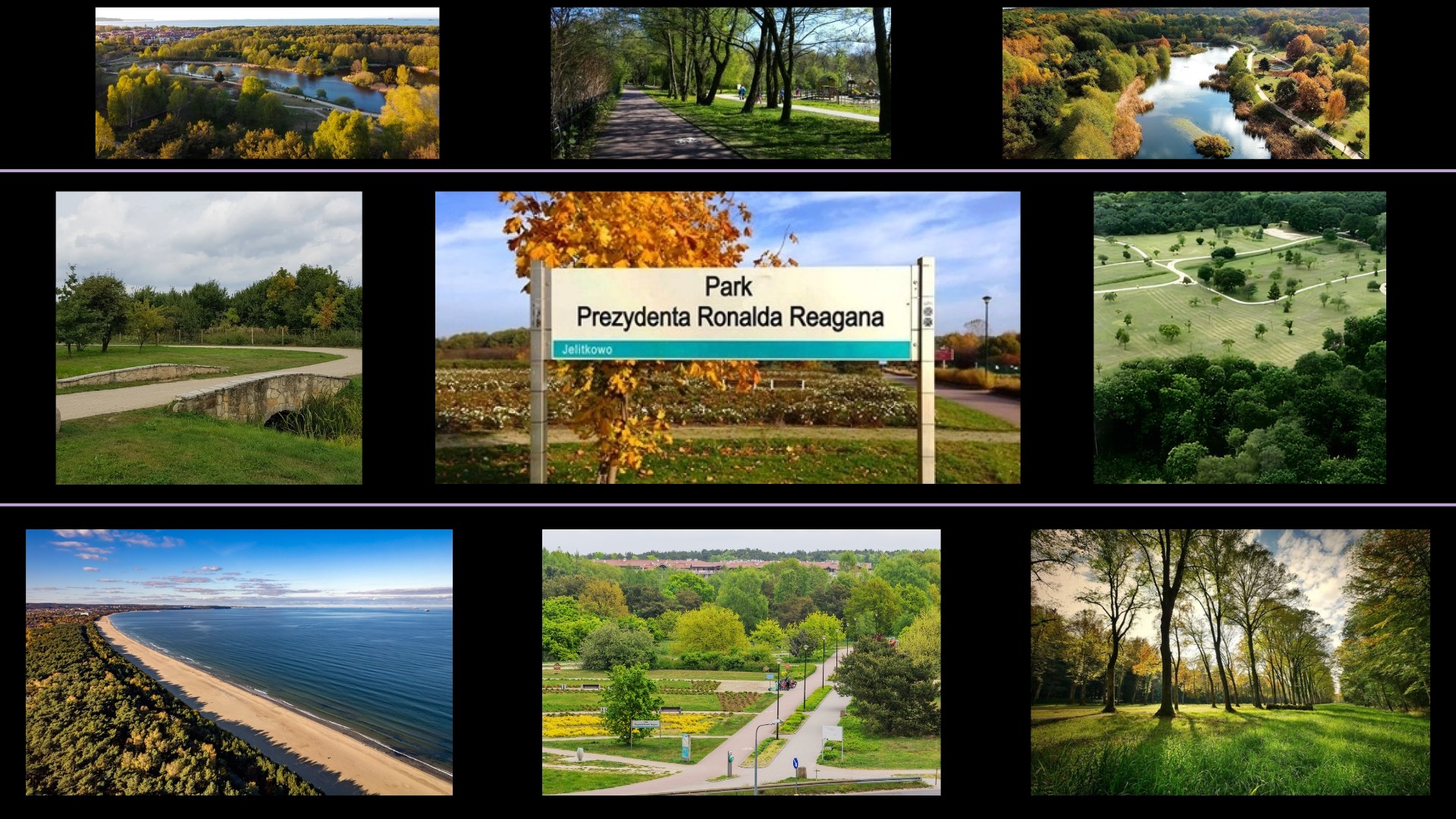
The Park Through Four Seasons
Spring in Park Reagana means cherry blossoms along the walking paths, dense resin scent from the coniferous forest, and green bursting through after months of gray. Fall turns the deciduous forest into a palette of yellows and oranges. The wooden crossings over water look completely different from their summer version.
The bronze monument of Reagan and John Paul II commemorates their meeting in Miami in 1987. It stands deep inside the park, and very few people plan it as a destination. Stopping by for 2 to 3 minutes gives you a moment to catch your breath between legs of the route.
Families with kids can spend a full day here without needing to go anywhere else. The playground, ponds, forest, and beach behind the dunes fold into one continuous plan. Runners and cyclists use the extensive path network that connects the park directly to Sopot. In the evening, after sunset over the bay, the boardwalks along the canals and the coniferous forest carry a different energy.
Park Oruński. The Hilly Park Poets Called a "Paradise Eden"
Park Oruński in Gdańsk covers 19 hectares in the Orunia-Św. Wojciech-Lipce district. The second-largest historical park in the city is set in the valley of Potok Oruński (Orunia Stream). Its history goes back to the turn of the 16th and 17th centuries, when Gdańsk aldermen and merchants had their residences here, with the land decorated by hunting lodges. Eighteenth-century gardens laid out in the English style, destruction during the Napoleonic wars, and twentieth-century reconstruction in a scaled-down form. Gdańsk poet Hans Georg Siegler described the place during the interwar period as a "paradise Eden."
The character of Park Oruński differs from Park Oliwski. Less geometry, more wildness. Hills, Potok Oruński, dense tree cover, ponds with cascades, and streams create terrain that looks more like a forest in a valley than a city park.
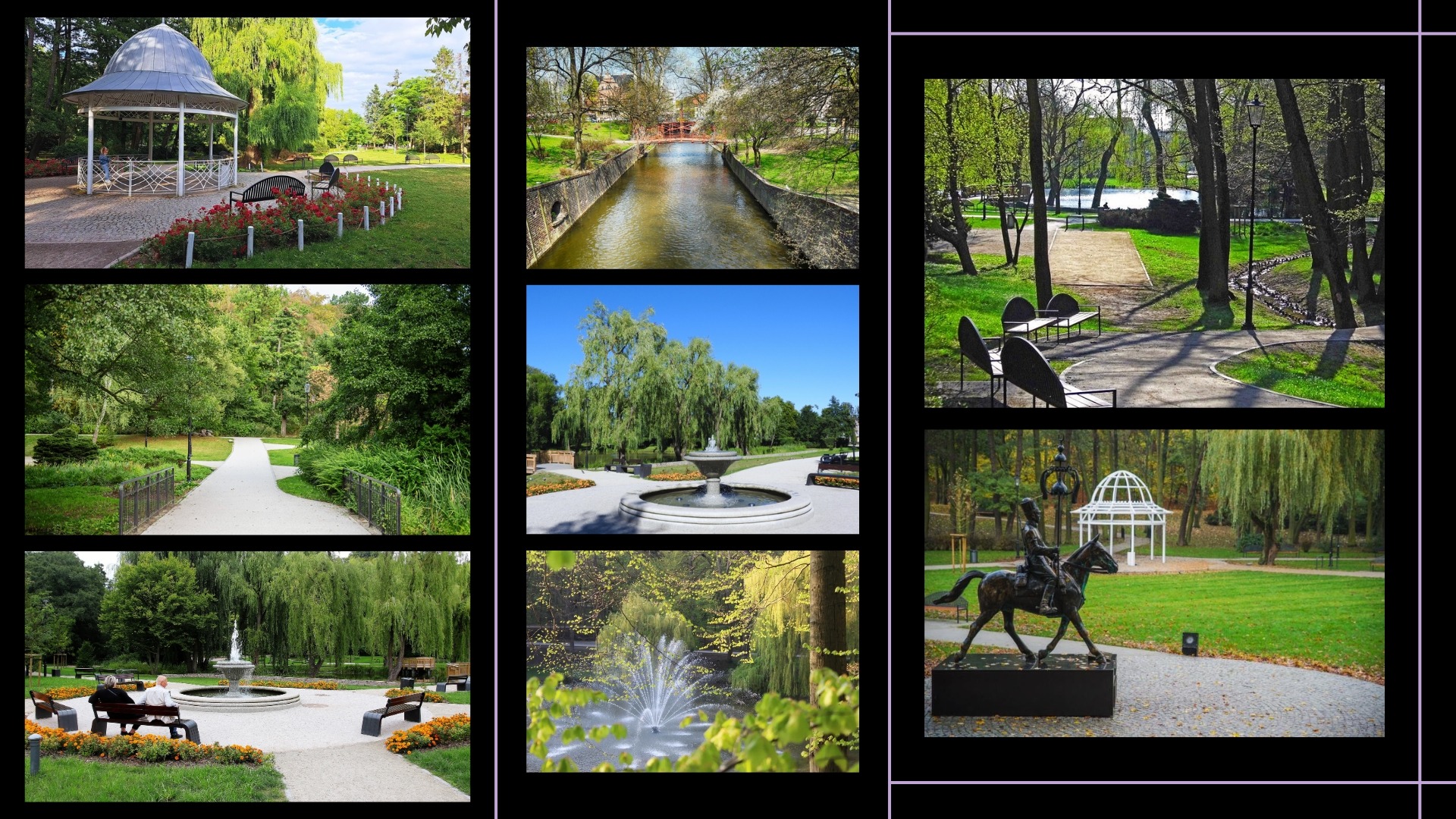
The Short Route, the Long Route, and the Underground One
The main route is an asphalt loop around the western pond, flat and paved, accessible for strollers. The loop takes 20 to 30 minutes at a slow pace. With some patience and luck, you can spot a freshwater turtle that occasionally comes ashore.
The amphitheater (Scena Muzyczna) next to the park hosts summer concerts and neighborhood events organized by the Gdańsk Archipelago of Culture. A former ice house hidden under one of the hills is a detail most visitors miss. A 19th-century manor stands at the park's edge.
The extended route leads through hills and wooded corners with uneven surfaces and viewpoints over the valley of Potok Oruński. The Augustowska retention basin, a brick structure from 1869 with an arched interior resembling a Gothic cathedral, sits right next to the park and counts as a separate attraction on the Gdańsk Waterworks Trail.
Park nad Opływem Motławy. Bastions, Water Lilies, and Nobody in Line
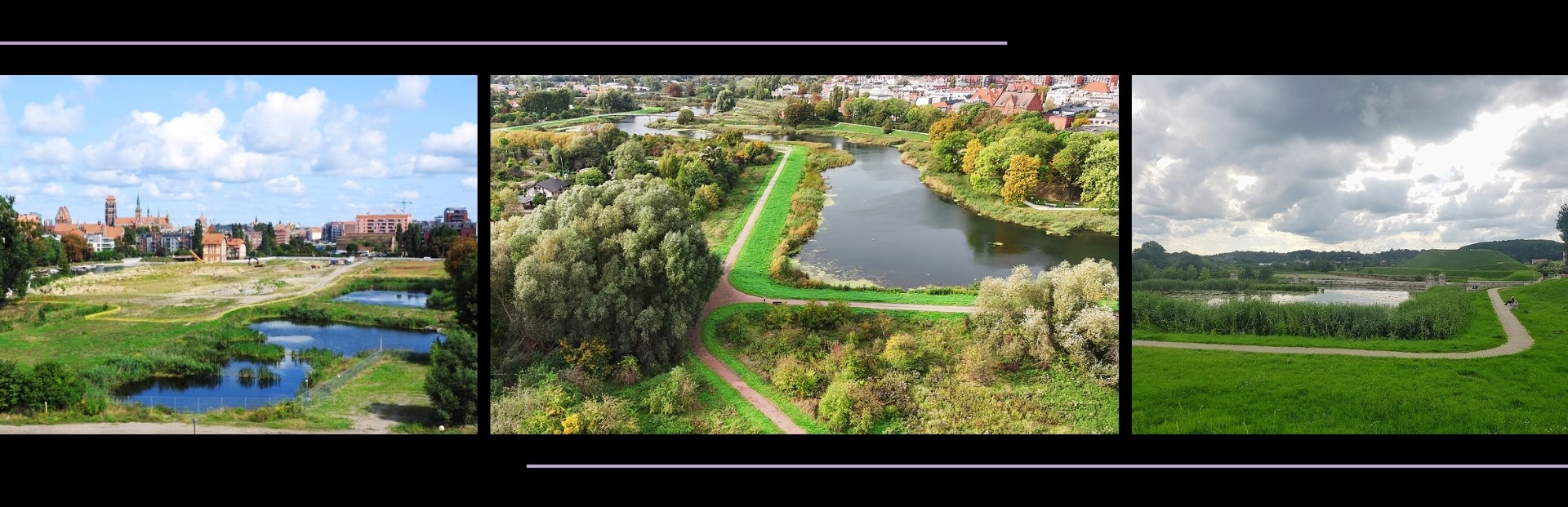
This 11-hectare walking and recreation park runs along the northern bank of the Opływ Motławy, on the grounds of 16th and 17th-century fortifications. Bastion Św. Gertrudy, Bastion Wilk, Bastion Żubr, Brama Nizinna, Śluza Kamienna. The names sound like they belong in a history textbook, and they stand a few hundred meters from the tourist center of the city.
A large-scale revitalization in the late 1990s restored the site's role as a park. Over 5 km of embankments on the northern and southern banks of the Opływ were renovated, and 8 km of walking and cycling paths appeared, along with period-style lanterns and benches. Resting spots and viewpoints were added on top of the bastions. In 2007, the park won the first prize from the Polish Society of Urban Planners in the "Green Space" category. Since 2009, the Plac Wałowy grounds and the bastions along the Motława have served as the stage for FETA, the Festival of Open-Air and Street Theater.
Casemates, the Stone Lock, and Hawthorns Doubling as Fortifications
Bastion Św. Gertrudy (1607–1638) is the best-preserved section of the western line of fortifications. Its casemates, covering roughly 4,000 m², once served as a gunpowder magazine; during World War II, they functioned as a hospital and morgue. A small kayak dock operates near Bastion Wilk.

Śluza Kamienna (the Stone Lock) is a 17th-century feat of hydraulic engineering that allowed the Motława to flow through the line of fortifications. Old hawthorns planted in rows grow along the paths. The thorny shrubs once reinforced the bastions' defenses. Educational plaques on the bastions contain fragments of residents' memoirs and quotes from postwar Gdańsk newspapers.
Protected plant species grow directly in the water of the Opływ, including white water lilies and yellow water lilies. On the surface, you can spot great crested grebes, swans, and moorhens.
The Quiet Park That Won a National Award
Six out of ten articles about parks in Gdańsk skip Park nad Opływem. No palm house, no grotto, no open-air sculptures mean it's hard to get a flashy cover photo for a guidebook. What it has is something the more popular parks lack. Quiet in the middle of the day, water, a view onto the Motława, and zero lines for anything.
Three Green Detours for When You've Done the Classics
❇️ Park w Królewskiej Dolinie (Royal Valley Park) on Sobieskiego Street is a revitalized green space named after visits by crowned heads, primarily King Jan III Sobieski and Queen Marysieńka (1677) and Augustus II the Strong (1717). Historic buildings from 1883 (the former Wilhelm and Augusta Institute for the Blind) stand among stone pathways and old plantings. After the war, the park fell into neglect, and only in recent years have restored public access. Practically zero tourist traffic. A pick for anyone looking for a solitary walk in the middle of the city without realizing they're in the middle of the city.
❇️ Dolina Radości (Valley of Joy) lies along Potok Oliwski within the Trójmiejski Park Krajobrazowy (Tricity Nature Park), next to the Gdańsk Zoo and the water-powered forge. Hiking trails, bike paths, dense forest. It connects well with Park Oliwski and the Oliwa Forest to form a single loop taking 2 to 3 hours at a recreational pace. The grounds are open with no time restrictions.
❇️ Park Brzeźnieński im. Haffnera is the most seaside park in Gdańsk, established in 1875 as a spa park. 7.4 hectares at the mouth of Potok Oliwski where it meets the Baltic, next to the Jelitkowo beach. Old plane trees (a rarity in Gdańsk), a prewar linden-tree avenue. Smaller and quieter than the neighboring Park Reagana, with the sea just as close.
How to Match the Green Space to the Day?
🌳Park Oliwski works best in the morning, when the Whispering Grotto functions without crowd noise and the Palm House has no line. The tram from the center takes about 20 minutes. On rainy days, the Palm House and the Abbots' Palace (a branch of the National Museum) provide shelter.
🌳Park Reagana is a plan for an afternoon rolling into sunset over the bay. The tram from the center takes about 25 minutes. In summer, it pairs well with the beach in Jelitkowo. On windy days, the coniferous forest blocks gusts from the bay better than the open promenade.
🌳Park Oruński handles any weather and any time of day because the dense canopy provides cover in both heat and drizzle. The bus from the center takes about 20 minutes. Pairs well with the Augustowska Retention Basin as a separate stop along the route.
🌳Park nad Opływem is a park for a lunch break or an after-work reset. Walking from the Old Town takes literally 10 minutes on foot and requires no public transit. Best time is late afternoon, when the light does the photographer's job for you.
🌳Park Oliwski + Dolina Radości, as a combined loop, takes 3 to 4 hours and makes the longest route mixing a historical garden with wild forest.
🌳Park Brzeźnieński pairs well with Park Reagana if you're looking for a quieter version of seaside green.
From the Japanese Garden in Oliwa to Japanese Fusion on Stępkarska
Every park in this guide has a point where the route runs out. The light changes, hunger takes over, and the next logical step is a table.
to.gather at Stępkarska 7 shifts character with the time of day. Before sunset, it works as a stop for coffee, a matcha latte, a dessert after a walk, or a calm conversation at a table with a lamp. After dark, the interior switches. Neon lines, a reflective ceiling, ambient gradually giving way to deep house. Signature cocktails designed to make a visual impression before you take your first sip.

The Better be together philosophy comes down when you walk in after the park, stay for dinner, and leave feeling like the day had a logical arc from the first step on the path to the last sip at the table.